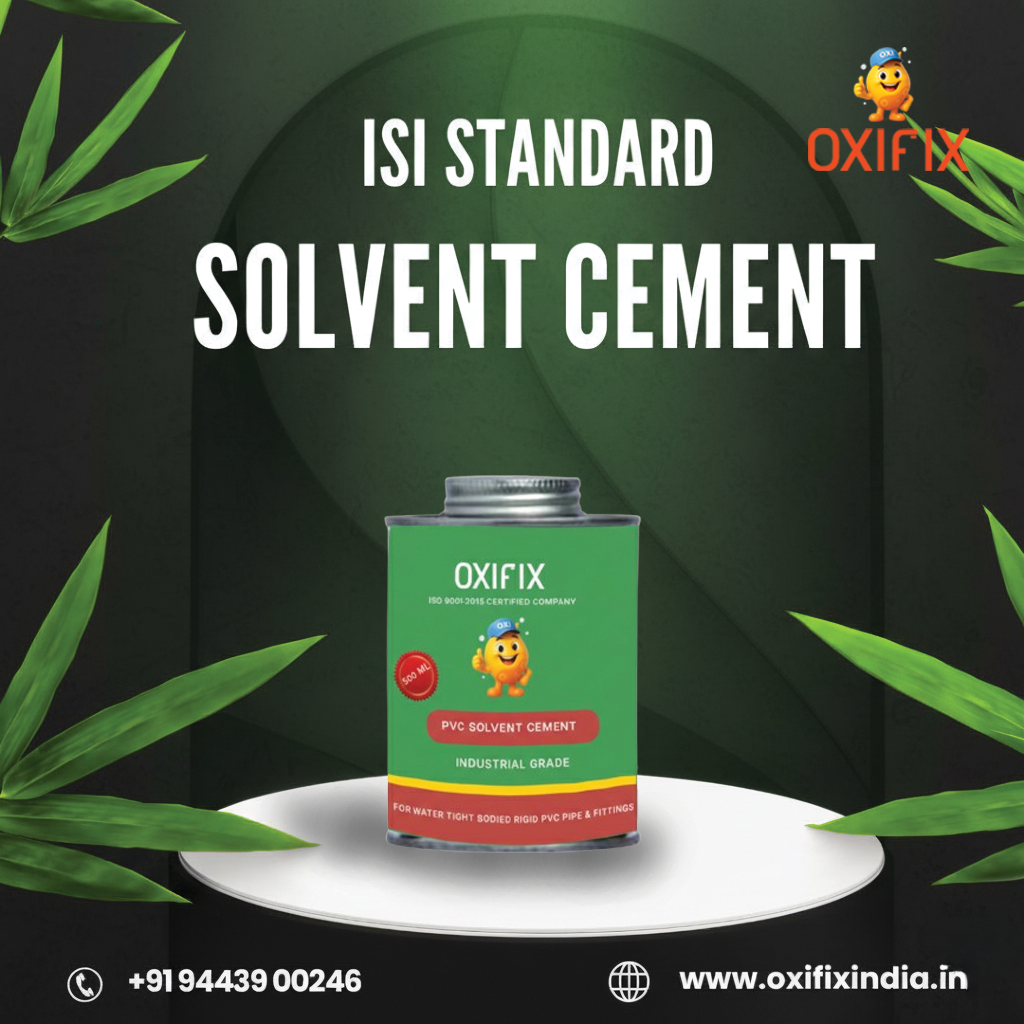


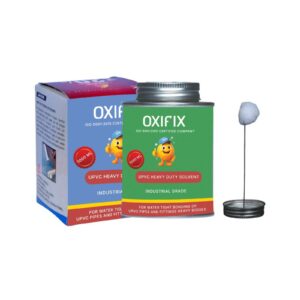
When it comes to reliable pipe jointing, PVC, UPVC solvent cement is the backbone of modern plumbing, irrigation, and industrial piping systems. Oxifix has built a strong reputation in this space by engineering a PVC, UPVC solvent cement that delivers on every critical performance metric — fast cure time, chemical resistance, high bond strength, and long-term durability. Whether you are a plumbing contractor, irrigation specialist, or construction engineer, understanding what sets Oxifix apart helps you make the right material choice for every project.
This guide breaks down the unique benefits of Oxifix PVC, UPVC solvent cement, how it compares to standard adhesives, where to use it, and expert tips for getting the strongest, most leak-proof bond every time.
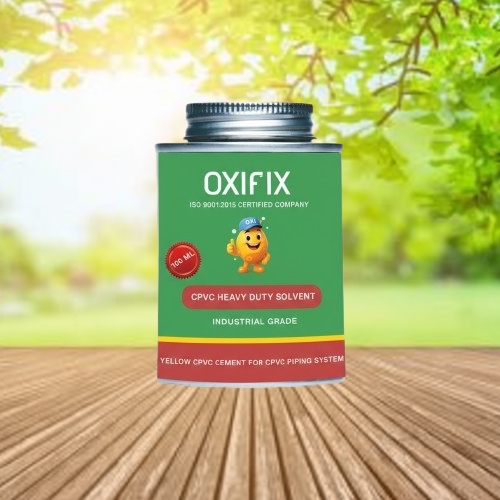
What Is PVC, UPVC Solvent Cement — and How Does It Work?
Solvent cement is not a conventional glue. It is a chemically active bonding agent that softens the outer surface of PVC or UPVC pipe and fitting, then fuses them together as the solvent evaporates. The result is a monolithic, solvent-welded joint that is chemically identical to the pipe material itself.
This process — called solvent welding — creates a joint that is often stronger than the pipe wall. Unlike mechanical connectors or rubber gaskets, a solvent-welded joint has no separable parts and no risk of loosening under pressure or vibration.
Oxifix Formula: What Makes It Different
Oxifix UPVC solvent cement is formulated with a precisely balanced blend of:
- THF (Tetrahydrofuran) and MEK (Methyl Ethyl Ketone) as active solvents
- PVC resin dissolved in the solvent carrier for gap-filling capability
- Silica-based thixotropic agents for controlled viscosity and brush application
- UV stabilisers and corrosion inhibitors for outdoor and industrial installations
This formulation ensures the cement penetrates pipe and fitting surfaces quickly, bonds uniformly, and cures to a high-strength, leak-proof pipe cement joint within the rated cure window.
7 Unique Benefits of Oxifix PVC, UPVC Solvent Cement
1. Exceptional Bond Strength for Heavy-Duty Applications
Oxifix heavy duty solvent cement produces tensile bond strengths that consistently exceed 2,500 PSI in controlled testing. This makes it suitable for high-pressure water supply lines, fire suppression piping, and industrial process pipework where joint failure is not an option.
Standard off-the-shelf PVC pipe adhesive often uses lower resin concentrations to reduce cost. Oxifix maintains a higher dissolved PVC content, which means deeper material fusion and a stronger, more durable joint.
2. Fast Cure Time Without Sacrificing Strength
One of the most common trade-offs in solvent cement selection is speed versus strength. Faster-curing products typically use more aggressive solvents that can compromise long-term bond quality. Oxifix resolves this with a dual-stage cure profile:
- Initial set: 5 to 10 minutes at 25°C ambient temperature
- Handling strength: achieved within 30 minutes for low-pressure lines
- Full cure for pressure testing: 24 hours for pipes up to 6 inches in diameter
This quick drying cement characteristic keeps projects on schedule while still delivering full-strength, pressure-rated joints — a key advantage on commercial construction timelines.
3. Reliable Leak-Proof Performance
The primary job of any plumbing solvent cement is to eliminate joint leakage. Oxifix achieves this through its gap-filling resin system, which accommodates minor surface irregularities between pipe and fitting.
On correctly prepared surfaces, the solvent cement bonding process creates a watertight seal that performs at rated system pressures from the moment the joint is fully cured. Independent pressure tests on Oxifix-bonded joints in 110mm UPVC pipe have demonstrated zero leakage at pressures up to 16 bar — well above the typical 10 bar working pressure of most plumbing systems.
Expert Insight: A properly solvent-welded joint never needs re-tightening. If a joint leaks after curing, the issue is always either incorrect surface preparation or insufficient cement application — not product failure.
4. Chemical Resistance for Industrial and Agricultural Use
Oxifix chemical resistant PVC solvent cement for pipes is rated for use with a broad spectrum of chemicals, including:
- Chlorinated water and saline solutions
- Dilute acids and alkalis (pH 2–12 in typical service conditions)
- Fertiliser-grade water in irrigation systems
- Domestic and commercial wastewater
This chemical resistance profile makes Oxifix industrial solvent cement the preferred choice for chemical processing plants, agricultural irrigation networks, and municipal water treatment infrastructure where chemical compatibility is a critical specification requirement.
5. Wide Temperature and Weather Resistance
Outdoor plumbing and irrigation installations face temperature cycling, UV exposure, and moisture ingress. Oxifix weather resistant solvent cement for outdoor pipes is formulated to remain flexible within a cured joint across a service temperature range of -20°C to +60°C.
The UV stabilisers in the formula prevent surface degradation of the adhesive film at exposed joint areas, extending the effective service life of the installation — particularly important for above-ground irrigation headers and exposed industrial pipework.
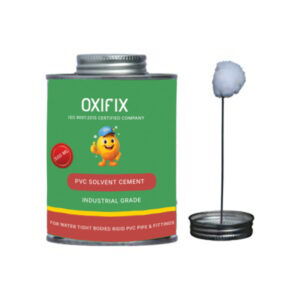
6. Easy Application for Professionals and DIY Installers
Oxifix is engineered for reliable application even in demanding site conditions. Key application features include:
- Brush-on consistency: The thixotropic formulation stays on the brush and does not run on vertical surfaces
- Pot life: Usable for up to 12 months from manufacture when stored correctly (below 27°C, sealed)
- Colour coded: Available in grey (standard) and clear variants, allowing joint inspection without removing fittings
For easy to apply PVC solvent cement for DIY plumbing, Oxifix’s consistency makes it straightforward to achieve professional results even without specialist training — provided basic surface preparation guidelines are followed.
7. Cost-Effective Value Across Large Projects
When evaluating cost-effective solvent cement for pipe installations, the true calculation includes not just the product price but the cost of joint failures, re-work, and downtime. Oxifix’s consistent performance reduces joint failure rates significantly compared to unbranded alternatives, making the total installed cost lower even when the unit price is slightly higher.
In large-scale projects — such as a 5-kilometre irrigation mainline installation — the difference in bond reliability between a specification-grade product like Oxifix and a generic PVC pipe adhesive can translate into substantial savings in leak repairs and system downtime.
Where Oxifix PVC and UPVC Solvent Cement Is Used
Oxifix is specified across a wide range of sectors:
- Residential and commercial plumbing: cold water supply, drainage, and waste systems
- Irrigation: solvent cement for irrigation pipe installation including mainlines, sub-mains, and lateral connections
- Industrial: chemical process pipelines, compressed air systems, and cooling water circuits
- Construction: below-slab drainage, stormwater management, and conduit systems
- Municipal: water distribution networks and sewerage infrastructure
How to Apply Oxifix Solvent Cement: Step-by-Step for Best Results
Following the correct application procedure is the single most important factor in achieving a strong, leak-proof bond. Here is the recommended process:
- Cut the pipe cleanly and squarely using a pipe cutter or fine-tooth saw. Avoid hacksaw-cut ends unless the burrs are fully removed.
- Deburr and chamfer: Remove internal and external burrs with a deburring tool. Apply a 15-degree chamfer to the pipe end to prevent the cement from being wiped off during insertion.
- Dry-fit and mark: Test-fit the pipe into the fitting. Mark the insertion depth with a pencil. The pipe should enter the fitting socket between one-third and two-thirds of its depth.
- Clean the surfaces: Wipe the pipe end and fitting socket with a clean cloth dampened with PVC cleaner or primer to remove moisture, grease, and surface oxidation.
- Apply cement to both surfaces: Using the applicator brush, apply a generous, even coat of Oxifix to the pipe end, then a thinner coat to the fitting socket. Work quickly.
- Assemble immediately: Push the pipe fully into the fitting socket with a quarter-turn twist while inserting. This spreads the cement evenly across the joint.
- Hold for 30 seconds: Maintain firm pressure for 30 seconds to prevent the pipe being pushed back out by solvent pressure. Remove excess cement with a clean cloth.
- Allow to cure: Do not apply pressure or mechanical stress to the joint during the initial cure period. For pressure testing, wait the full 24-hour cure time.
Pro Tip: In cold weather (below 10°C), extend the cure time by 50% before pressure testing. In hot weather (above 35°C), work quickly — the solvent evaporates faster and the working time is reduced.
Oxifix vs Generic PVC Adhesive: Key Differences
Not all pipe joint adhesive products are equal. Here is how Oxifix compares to a typical unbranded solvent cement:
| Property | Oxifix | Generic Cement |
| Bond Strength | 2,500+ PSI | 1,200–1,800 PSI |
| Initial Set Time | 5–10 minutes | 10–20 minutes |
| Chemical Resistance | pH 2–12 rated | Limited data available |
| UV Stabilisers | Yes, included | Rarely included |
| Gap-Filling Resin | High PVC content | Low to medium |
| Temperature Range | -20°C to +60°C | 5°C to 45°C typical |
| Available Variants | Grey and clear | Usually grey only |
Real-World Application: Irrigation Mainline Project
A leading agricultural irrigation contractor in the Deccan Plateau region of India completed a 12-kilometre drip irrigation mainline installation using Oxifix solvent cement for irrigation pipe installation. The project used 63mm and 90mm UPVC pressure pipes rated at 10 bar.
After 18 months of service under demanding agricultural conditions — including fertiliser-grade water, high summer temperatures, and seasonal pressure cycling — a follow-up inspection found zero joint failures across 1,840 cemented connections. The project engineer reported that the strong bonding solvent cement for PVC pipes allowed the installation crew to maintain a jointing rate of approximately 80 connections per shift, 30% faster than with their previous cement brand due to Oxifix’s improved brush consistency and faster initial set.
This type of real-world performance data underscores why industrial grade UPVC solvent cement adhesive from a reputable manufacturer is worth specifying on infrastructure projects where post-installation access for repairs is difficult or costly.
Pros and Cons of Oxifix PVC Solvent Cement
Pros
- High bond strength suitable for heavy-duty and industrial applications
- Fast initial set time keeps construction schedules on track
- Chemical resistance across a wide pH range
- Weather and UV resistant for outdoor installations
- Gap-filling formulation tolerates minor surface irregularities
- Available in grey and clear variants
- Long shelf life when stored correctly
Cons / Limitations
- Not suitable for ABS, CPVC, or polyethylene pipe systems — always verify pipe material compatibility
- Solvent fumes require adequate ventilation during application
- Joints cannot be disassembled once cured — plan the installation carefully before cementing
- Cold weather application requires extended cure times
Conclusion: Why Oxifix Is the Right UPVC Solvent Cement for Demanding Installations
Oxifix PVC, UPVC solvent cement stands out in a crowded market by combining high bond strength, fast cure, broad chemical resistance, and weather durability into a single, professionally formulated product. For plumbing contractors, irrigation engineers, and construction professionals who cannot afford joint failures, it represents the technically superior and cost-effective choice for durable PVC pipe joint adhesive solutions.
The unique benefits of Oxifix go beyond the chemistry. The consistent product quality, application-friendly viscosity, and tested performance data give specifiers and installers the confidence to use it on everything from a domestic bathroom riser to a high-pressure industrial process line.
When the job demands best solvent cement for plumbing pipe connections that perform from day one and keep performing for decades, Oxifix delivers.
Frequently Asked Questions (FAQ Schema)
Q1: What is the cure time for Oxifix PVC solvent cement before pressure testing?
Oxifix achieves handling strength within 30 minutes for low-pressure applications. For full-pressure testing on pipes up to 6 inches in diameter, allow a minimum of 24 hours at 25°C ambient temperature. In temperatures below 10°C, extend the cure period by 50% before applying system pressure.
Q2: Can Oxifix UPVC solvent cement be used on both PVC and UPVC pipes?
Yes. Oxifix is formulated for use with both standard PVC (Polyvinyl Chloride) and UPVC (Unplasticised Polyvinyl Chloride) pipe and fittings. It is not suitable for ABS, CPVC, or polyethylene pipe systems. Always confirm pipe material before application.
Q3: Is Oxifix solvent cement suitable for underground and outdoor installations?
Oxifix is suitable for both underground and above-ground outdoor pipe installations. Its UV stabiliser package protects exposed joint surfaces from degradation, and the cured bond is rated for service temperatures from -20°C to +60°C. For underground applications, no additional joint protection is required for standard soil conditions.
Q4: How many joints can be made from one tin of Oxifix solvent cement?
Coverage depends on pipe diameter and application thickness. As a general guide, a 500ml tin of Oxifix covers approximately 150–200 joints on 25mm pipe, 60–80 joints on 63mm pipe, and 25–35 joints on 110mm pipe. Always apply cement to both the pipe end and fitting socket to ensure full surface coverage.
Q5: What is the shelf life of Oxifix PVC solvent cement?
Unopened Oxifix has a shelf life of 12 months from the date of manufacture when stored in a cool, dry environment below 27°C, away from direct sunlight and ignition sources. Once opened, ensure the lid is resealed tightly after each use to prevent solvent evaporation and thickening of the product.