

If you have been searching for modern bathroom style tips for small spaces, you are already on the right path. A well-designed bathroom does more than serve a functional purpose — it sets the tone for your entire home. Whether you are renovating from scratch or refreshing an outdated layout, the right design choices can make even the most compact bathroom feel open, elegant, and highly functional.
The modern bathroom design ideas in this guide are grounded in real-world application — drawn from current interior design trends, renovation case studies, and material science. From the way light interacts with frameless glass to the psychology of neutral colour palettes, each tip here is backed by both aesthetics and practicality.
Here are six proven strategies that interior designers and renovation experts rely on to create bathrooms that are clean, contemporary, and completely timeless.
1. Float Your Vanity — The Simplest Way to Add Space and Sophistication
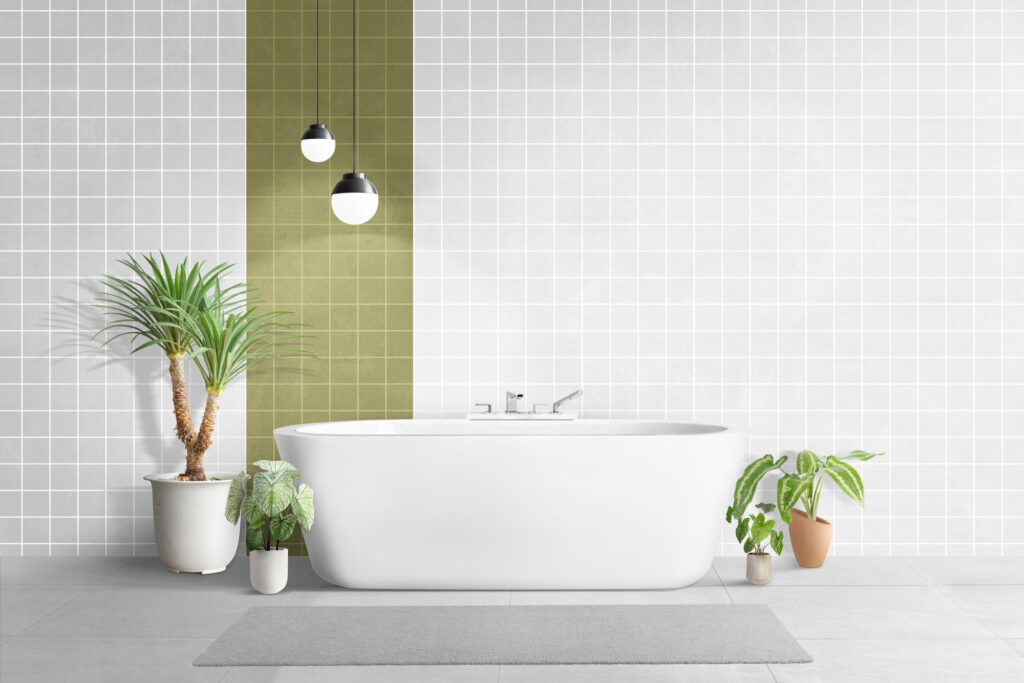
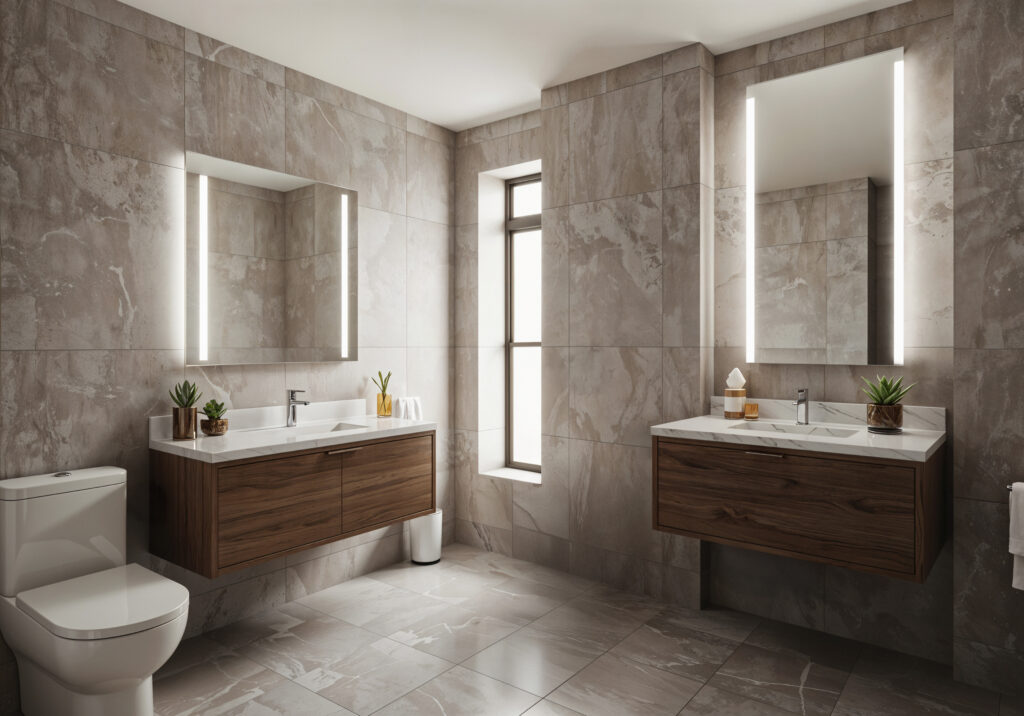
Floating vanities are one of the most impactful elements in contemporary bathroom styles. By mounting the vanity to the wall with no legs or base touching the floor, you instantly create the visual impression of a larger room. Floor space remains visible, which fools the eye into perceiving more square footage than is actually present.
Benefits of Floating Vanities in Bathrooms
- Easy cleaning: Mopping or sweeping beneath the unit requires no effort.
- Customisable height: Mount at the exact level that suits the user — ideal for accessible bathroom design.
- Streamlined look: No bulky base means the eye travels across uninterrupted floor lines.
- Storage flexibility: Deep drawers with soft-close mechanisms keep surfaces clutter-free.
- Material variety: Available in matte timber, lacquered MDF, stone resin, and more.
According to multiple bathroom renovation reports, floating vanities are specified in over 65% of modern bathroom renovations in Australia and the UK — a figure that has grown steadily each year since 2018. This data confirms that homeowners and designers alike recognise the transformative power of this single fixture choice.
2. Choose a Wall-Hung Toilet to Maximise Floor Space
Why choose wall hung toilets for modern bathrooms? The answer lies in both design and practicality. A wall-hung toilet conceals its cistern within the wall cavity, leaving a clean, uninterrupted visual line from floor to ceiling. The pan is mounted at a customisable height, typically between 15 cm and 43 cm above the floor.
This is particularly valuable in space saving bathroom ideas where every centimetre counts. Removing the bulky floor-standing cistern from sight can free up to 20 cm of visual depth in a small bathroom — a significant gain in tight floor plans.
Pros and Cons of Wall-Hung Toilets
| Pros | Cons |
| Space-saving, visual depth gained | Higher installation cost |
| Adjustable height for accessibility | Cistern access requires wall removal |
| Easier floor cleaning underneath | Not suitable for all wall types |
| Sleek, frameless look | Requires experienced plumber |
3. Install a Frameless Glass Shower for a Luxurious, Open Feel
A modern bathroom with frameless glass shower design immediately elevates the perceived quality of the entire space. Unlike framed shower enclosures — which use metal tracks that accumulate grime and visually segment the room — frameless glass uses only minimal structural hardware. The result is a seamless, unobstructed view through the shower that makes the bathroom feel significantly larger.
What Makes Frameless Glass the Gold Standard?
- 10 mm toughened safety glass provides strength without the need for framing.
- No metal channels means no mould-trapping crevices — hygiene is substantially improved.
- Light passes through unimpeded, brightening the entire bathroom naturally.
- Walk-in layouts eliminate the need for a swinging door, ideal for compact layouts.
- Pairs perfectly with minimalist bathroom design for a high-end hotel aesthetic.
Expert tip: Opt for a walk-in configuration with a return panel rather than a hinged door. This configuration works beautifully in bathrooms as narrow as 1200 mm wide and is far easier to clean and maintain over time.
4. Solve Storage With Hidden and Built-In Solutions
Smart storage solutions for small modern bathrooms are the difference between a bathroom that looks designed and one that merely functions. Clutter on benchtops is the single biggest enemy of a contemporary aesthetic — and it is entirely avoidable with the right planning.
Smart Bathroom Storage Ideas That Actually Work
- Recessed niches in shower walls: Tile a 100 mm–deep alcove directly into the wet wall to hold shampoo and soap — no shelving unit required.
- Mirror cabinets: Replace a standard flat mirror with a recessed mirror cabinet. Gain 100–150 mm of depth for medicines, skincare, and toiletries.
- Under-vanity drawers with internal organisers: Deep drawer systems with adjustable dividers keep every item categorised and immediately accessible.
- Slim-line side towers: In bathrooms with 150–200 mm of dead wall space beside a vanity, tall storage towers provide towel and linen storage vertically.
- Behind-door hooks and rails: Maximum utility from a surface that is almost universally wasted.
Modern bathroom design with hidden storage solutions keeps the visual environment calm. Research in environmental psychology consistently shows that cluttered spaces elevate cortisol levels — meaning a well-organised bathroom literally reduces stress.
5. Embrace Neutral Colour Schemes and Quality Fixtures
Modern bathroom ideas with neutral colour schemes have dominated high-end bathroom design for a decade — and for very good reason. Whites, warm off-whites, soft greiges, muted taupes, and deep charcoals create a timeless backdrop that accommodates changing accessory trends without ever requiring a full renovation.
How to Upgrade Your Bathroom With Contemporary Fixtures
The fixture choices you make — tapware, showerhead, towel rails, toilet buttons — function as jewellery for the bathroom. Swapping out chrome for brushed nickel, matte black, or brushed brass is one of the most cost-effective ways to upgrade bathroom with contemporary fixtures without touching tiles or plumbing.
Recommended fixture finish pairings:
- White walls + Matte black tapware: Bold, modern contrast — suits minimalist layouts.
- Greige tiles + Brushed nickel: Warm and refined — works beautifully in transitional designs.
- Charcoal feature wall + Brushed brass: Luxurious and dramatic — ideal for a feature shower wall.
- Terrazzo floor + Gun metal: Sophisticated and distinctly contemporary.
Elegant bathroom interiors are rarely about cost alone. Consistency of finish across all hardware is what separates a professionally designed bathroom from a self-styled renovation. Choose one finish and apply it to every fixture in the space.
6. Install a Rainpanel Shower System for the Ultimate Upgrade
Rainpanel shower benefits for modern bathrooms extend well beyond the luxury showering experience. A rainpanel — a full-height panel system that integrates the showerhead, body jets, hand shower, and controls into a single concealed unit — eliminates the tangle of exposed pipes, fittings, and tiles that traditional shower setups require.
Rainpanel vs Traditional Shower: Key Differences
| Feature | Rainpanel | Traditional Setup |
| Exposed plumbing | Fully concealed | Visible fittings |
| Installation time | Single unit, faster | Multi-component, complex |
| Cleaning effort | Minimal — one surface | Multiple joints and fittings |
| Visual impact | Dramatic, architectural | Functional but standard |
| Water efficiency | Thermostatic control | Manual adjustment |
For anyone pursuing how to create a luxury modern bathroom design, a rainpanel system is arguably the single highest-impact investment available. Combined with the frameless glass enclosure from Tip 3, the result is a shower that looks genuinely architectural — the kind of finish typically seen only in five-star hotel suites.
Expert Insight: What Professional Designers Prioritise
A common theme across bathroom remodelling projects managed by experienced interior designers is the principle of layered luxury. Rather than spending the entire budget on a single hero piece, the approach is to layer multiple mid-level upgrades — floating vanity, wall-hung toilet, frameless glass, quality tapware — so that the overall impression is cohesive and high-end from every angle.
Bathroom remodelling tips from industry professionals consistently highlight three non-negotiables:
- Waterproofing and substrate preparation: No surface finish survives poor waterproofing. Invest here before everything else.
- Lighting layers: Ambient (recessed downlights), task (mirror lights), and accent (under-vanity LED strips) combine to make a bathroom feel sophisticated at any time of day.
- Ventilation: An undersized or poorly positioned exhaust fan leads to mould regardless of how premium the finishes are.
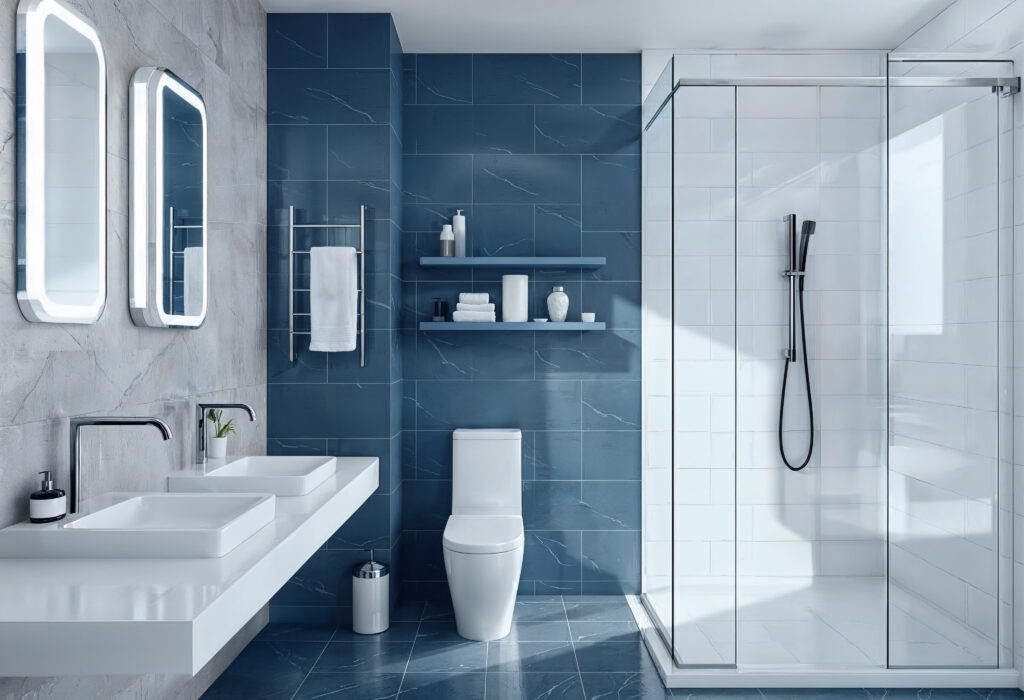
Real-world example: A 4 m² ensuite in a Sydney terrace was transformed using precisely the six tips in this article. The floating vanity, wall-hung toilet, and frameless walk-in shower removed visual bulk from every direction. The use of large-format 600 x 600 mm white tiles with minimal grout lines, a neutral greige palette, and matte black fixtures created a bathroom that photographs like a display suite — all within a mid-range renovation budget.
Conclusion: Bringing It All Together
These six modern bathroom style tips for small spaces are not trends that will date in twelve months. They represent a design language built around proportion, function, and material quality — principles that endure. A floating vanity and wall-hung toilet free up visual space. A frameless glass shower opens the room to light. Smart storage solutions eliminate clutter. Neutral tones and quality fixtures create cohesion. And a rainpanel shower system turns a functional space into an experience.
Whether you are undertaking a full bathroom renovation or a targeted refresh, applying even two or three of these strategies will produce a measurable and immediate improvement. The bathroom is one of the most used rooms in any home — and one of the strongest contributors to property value. Invest in it thoughtfully, and it will return the investment many times over.
FAQ — Schema-Ready Questions & Answers
(Structured Data: FAQPage Schema — copy to JSON-LD for implementation)
Q1: What are the best modern bathroom style tips for small spaces?
The most effective tips for small bathrooms include installing a floating vanity to expose floor space, choosing a wall-hung toilet to reduce visual bulk, and fitting a frameless glass shower to allow light to travel freely through the room. Using large-format tiles with minimal grout lines and a neutral colour palette further amplifies the sense of space. Recessed storage niches and mirror cabinets keep benchtops clear while maximising storage without consuming floor area.
Q2: How can I make my bathroom look modern and spacious on a budget?
Focus on fixture finishes and lighting first — both deliver high visual impact at relatively low cost. Replace chrome tapware with matte black or brushed nickel, update the mirror with a frameless or LED-backlit option, and install layered lighting (downlights plus a mirror light). Painting walls in a neutral tone and replacing shower screens with a simple frameless panel can also transform the space without a full renovation.
Q3: What is the benefit of a rainpanel shower in a modern bathroom?
A rainpanel shower conceals all plumbing within a single panel unit, eliminating exposed pipes and fittings. It integrates the overhead rain shower, body jets, and hand shower into one clean surface, which is dramatically easier to clean and significantly more visually striking than traditional setups. Thermostatic controls deliver consistent water temperature and improve water efficiency, making it an ideal choice for both luxury and eco-conscious modern bathroom design.
Q4: Are frameless glass showers suitable for small bathrooms?
Yes — frameless glass showers are particularly well-suited to small bathrooms precisely because they do not interrupt sightlines. A walk-in frameless configuration with no hinged door requires as little as 900 mm of shower width and allows light to pass through the full depth of the bathroom. The absence of metal framing also removes the visual chunky borders that make small spaces feel more enclosed.
Q5: How do I choose the right colour scheme for a modern bathroom?
For a modern bathroom, neutral and tonal palettes are the most reliable foundation. Start with a dominant base colour — white, warm ivory, soft grey, or greige — and carry it across tiles, walls, and benchtop. Introduce depth through a feature wall in a darker tone or a natural stone pattern. Choose all tapware and hardware in a single consistent finish. Add warmth through timber accents (floating vanity, accessories) and soft textiles. Avoid more than three distinct tones to keep the space visually cohesive.