

When it comes to building reliable, long-lasting drainage infrastructure, the quality of your pipe joints matters just as much as the pipes themselves. uPVC solvent cement is ideal for high-pressure drainage systems because it does not merely stick two pipe surfaces together — it chemically fuses them into a single, seamless unit. This molecular-level bonding eliminates leak paths entirely, which is why contractors, plumbing engineers, and industrial facility managers consistently choose solvent cement over mechanical couplings or rubber-ring joints in demanding drainage applications.
Whether you are working on a municipal stormwater network, a commercial building’s drainage stack, or an industrial wastewater line, understanding how solvent cement works — and why it outperforms alternatives — will help you make better material and installation decisions from the start.
What Is uPVC Solvent Cement and How Does It Work?
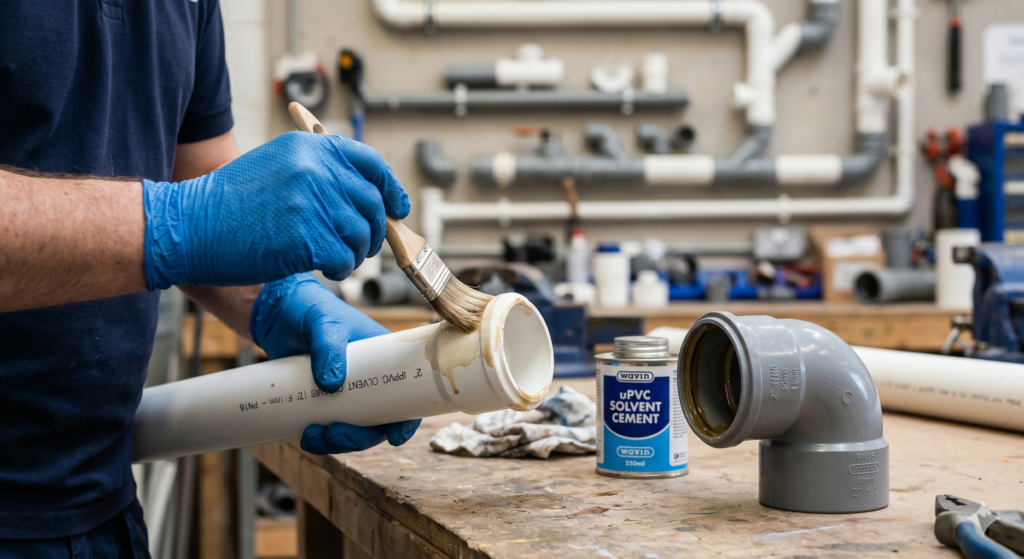
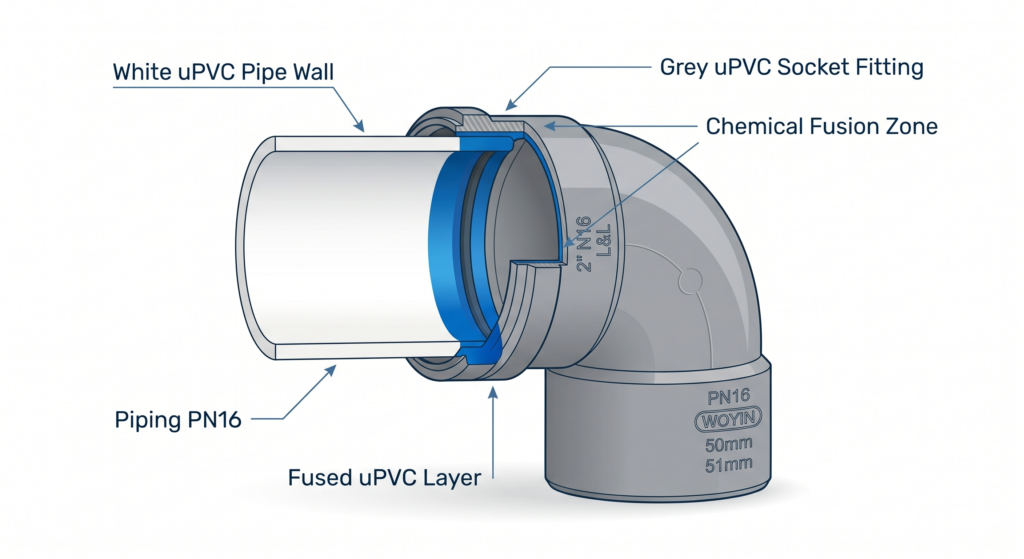
uPVC (unplasticised polyvinyl chloride) solvent cement is a specially formulated adhesive made from dissolved uPVC resin suspended in a blend of organic solvents — typically tetrahydrofuran (THF), methyl ethyl ketone (MEK), and cyclohexanone. When applied to a pipe end and fitting socket, the solvents soften and slightly dissolve both mating surfaces. As the joint is assembled and the solvents evaporate, the softened uPVC material from both surfaces intermingles and re-solidifies as one homogeneous mass.
This process is often called chemical welding, and it is fundamentally different from surface adhesion. A mechanical adhesive bonds to the outside of materials; solvent cement becomes part of the material itself. The result is a joint with tensile and pressure strength that frequently meets or exceeds the rated strength of the pipe wall.
Key chemistry facts:
- Cure time to initial handling strength: 15–30 minutes (at 23°C)
- Full cure to rated pressure: 24–72 hours depending on pipe diameter and ambient temperature
- Joint shear strength: typically 10–20 MPa for correctly made uPVC solvent-welded joints
- Operating temperature range: –10°C to +60°C for most standard formulations
Why High-Pressure Drainage Systems Demand Superior Pipe Joints
Standard gravity drainage operates at near-atmospheric pressure. High-pressure drainage systems are a different challenge entirely. These include:
- Pressurised sewer rising mains pumping sewage uphill over long distances
- Industrial process drainage carrying fluids at elevated head pressures
- High-rise building drainage stacks where hydraulic pressure surges occur during simultaneous fixture use
- Fire suppression drainage returns subject to sudden pressure spikes
- Vacuum drainage systems in marine and rail applications
In these environments, a joint failure is not just a maintenance inconvenience — it can mean toxic fluid release, structural water damage, or complete system shutdown. Rubber-ring push-fit joints, while adequate for gravity drainage, are rated for lower pressure thresholds and can disengage under sustained surge conditions. Threaded mechanical joints introduce stress concentrations. Solvent-welded joints, by contrast, distribute pressure load uniformly across the entire bonded surface area.
Core Benefits of uPVC Solvent Cement in Drainage Pipelines
1. Absolute Leak-Proof Pipe Joints
The chemical weld created by solvent cement leaves no gap, thread, or gasket through which fluid can migrate under pressure. Laboratory hydrostatic pressure tests consistently show that solvent-welded uPVC joints hold pressure above the pipe’s own burst rating — meaning the pipe barrel will fail before the joint does. For leak-proof pipe joints in pressurised drainage, this is the gold standard.
2. Pressure-Resistant Pipe Bonding Across the Full System
uPVC drainage pipe systems assembled with solvent cement behave like a single continuous conduit rather than a collection of discrete components. This monolithic behaviour is critical for pressure-resistant pipe bonding because pressure surges — known as water hammer — travel through the system as pressure waves. A jointed system with any mechanical flexibility can develop micro-movement at interfaces, leading to joint fatigue over time. A solvent-welded system has no such weak points.
Standard uPVC pressure pipe systems using solvent cement are rated for working pressures of 6 bar (Class C), 9 bar (Class D), and 12.5 bar (Class E) depending on pipe wall thickness, making them suitable for virtually any pressurised drainage application in building or civil infrastructure.
3. Outstanding Chemical Resistance in Wastewater Applications
Industrial and municipal drainage systems carry aggressive fluids: acids, alkalis, chlorinated water, organic solvents in trace concentrations, and biologically active sewage. The chemical resistance of uPVC solvent cement in wastewater systems is exceptional because the fused joint inherits the chemical resistance of the uPVC pipe itself.
uPVC is resistant to:
- Dilute acids and alkalis (pH 2–12)
- Chlorinated water and disinfectants
- Many petroleum-based hydrocarbons at low concentrations
- Biological degradation agents in sewage
The solvent cement matrix does not introduce a chemically weak interface. Unlike epoxy putties or polyurethane sealants that can swell, degrade, or delaminate in aggressive media, a solvent-welded joint is chemically homogeneous with the pipe body.
4. Easy Application with Consistent Results
One of the most practical advantages is how straightforward the application process is. Easy application solvent cement for plumbing systems reduces the skill gap between a highly experienced plumber and an intermediate-level installer. The process requires no heat equipment, no specialised tooling, and no complex calibration.
A standard installation requires:
- Cut the pipe square using a ratchet pipe cutter or fine-tooth saw
- Deburr and chamfer the cut end (15° bevel, approximately 2–3 mm)
- Clean both surfaces with the manufacturer’s cleaning agent or recommended solvent cleaner
- Apply primer (where specified) to open the PVC surface
- Apply solvent cement to the pipe OD and fitting socket using the supplied brush
- Assemble immediately with a quarter-turn, hold for 30 seconds
- Wipe off surplus cement and allow to cure
The entire process per joint takes under two minutes of active work time. This speed translates directly into lower installation labour costs on large drainage projects.
5. Long-Lasting, Durable Pipe Joint Solutions
A correctly made solvent-welded uPVC joint is effectively permanent. Unlike rubber gasket joints that require periodic inspection and replacement as elastomers age and harden, or mechanical couplings that can loosen from vibration, the chemical weld does not degrade over time under normal service conditions. Industry data from water utilities in the UK and Australia show solvent-welded uPVC drainage systems performing at specification after 40+ years of continuous service.
This durable pipe joint solution characteristic has significant lifecycle cost implications. When you factor in maintenance visits, joint re-sealing, and emergency repair costs over a 30-year infrastructure lifecycle, solvent-welded systems consistently show lower total cost of ownership than alternative joining methods.
6. Compatibility with Standard uPVC Fittings
uPVC solvent cement is formulated specifically for the uPVC pipe and fitting system. Standard BS EN 1452, ASTM D2466, or IS 4985 compliant fittings — elbows, tees, reducers, traps, inspection chambers — all use identical solvent-welding methodology, so there is no need for different joining techniques at different points in the system. This consistency simplifies training, quality control, and inspection.
Pros and Cons at a Glance
| Factor | Solvent Cement Joint | Rubber Ring Joint | Mechanical Coupling |
|---|---|---|---|
| Pressure rating | High (up to 12.5 bar) | Moderate (up to 6 bar) | Variable |
| Leak risk | Negligible | Low-moderate | Low |
| Installation speed | Fast (per joint) | Very fast | Moderate |
| Disassembly | Not possible | Easy | Easy |
| Chemical resistance | Excellent | Good | Depends on materials |
| Maintenance requirement | None | Periodic | Periodic |
| Cost per joint | Low | Very low | Higher |
When NOT to use solvent cement: If the system requires future disassembly — for inspection chambers, pump connections, or transition joints to other pipe materials — use flanged or union mechanical joints at those specific points and solvent cement for the fixed runs.
Expert Application Tips for Reliable High-Pressure Joints
Getting consistent results with solvent cement requires attention to several variables that are easy to overlook on site.
Temperature management is critical. Below 5°C, solvent evaporation slows dramatically, extending cure times to 48–96 hours and risking an incomplete cure if the joint is pressurised too early. Above 40°C ambient temperature, the solvents flash off too quickly before adequate surface fusion occurs. In hot climates, schedule solvent cementing for cooler parts of the day and shade work areas.
Surface preparation is the single most important factor in joint reliability. Oil, moisture, dust, and pipe-cutting lubricant all compromise the bond. Always wipe surfaces with a clean, dry cloth before applying cleaner, and allow the cleaner to flash off fully before applying cement.
Correct cement quantity matters more than most installers realise. Too little cement means incomplete fusion; too much introduces excess solvent that can pool inside the pipe bore and create a weak, solvent-rich zone. A correctly cemented joint should produce a small, uniform bead of cement around the full circumference of the socket face upon assembly — not a large drip.
Cure time discipline is non-negotiable on high-pressure systems. Follow the manufacturer’s cure schedule strictly. On large-diameter pipes (110 mm and above), full-cure wait times before pressure testing should be 48–72 hours even under ideal conditions.
Real-World Application: Industrial Effluent System, Tamil Nadu Manufacturing Facility
A chemical processing plant in the Cuddalore industrial corridor needed to replace a corroded cast-iron effluent drainage system carrying mildly acidic cooling water returns at 3.5 bar operating pressure. The replacement specification called for DN 110 and DN 160 uPVC Class D pressure pipe with solvent-welded joints throughout, with the exception of flanged connection points at pump discharge headers.
After installation by a local MEP contractor using a certified solvent cement compliant with IS 14182, the system was hydraulic pressure-tested at 1.5 times working pressure (5.25 bar) for two hours with zero joint failures across 347 solvent-welded joints. The plant maintenance engineer noted that previous rubber-ring jointed sections had required three re-sealing interventions in five years; the new solvent-welded section had required none in the 30 months since commissioning at time of reporting.
This kind of real-world performance confirms why uPVC solvent cement for drainage has become the specification default on industrial and commercial pressurised drainage projects across South Asia.
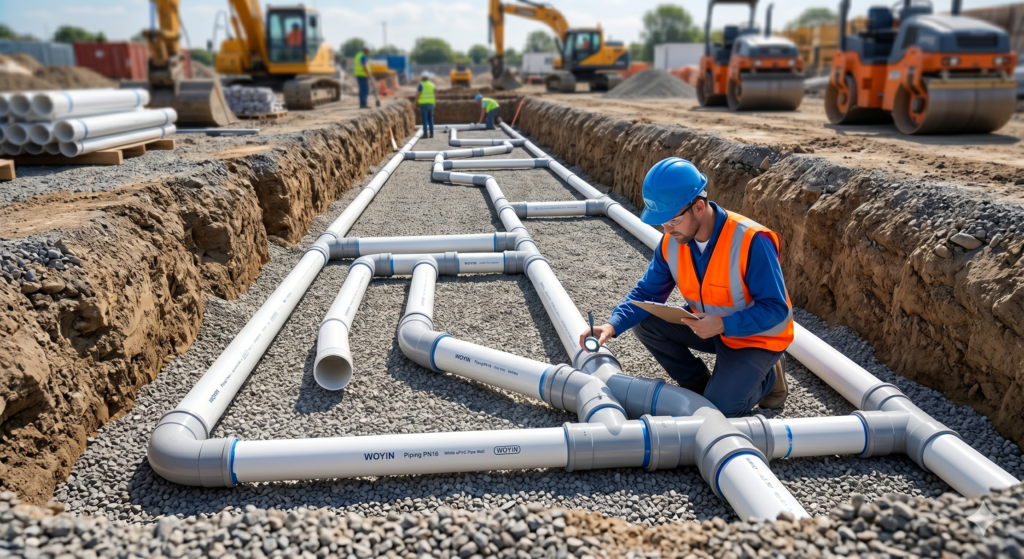
How to Ensure Leak-Proof Drainage Pipe Connections: A Checklist
Use this field checklist before, during, and after solvent cementing high-pressure drainage joints:
Before work:
- Confirm cement is approved for the pipe material and pressure class
- Check cement expiry date (typical shelf life: 12–24 months from manufacture)
- Verify ambient temperature is within 5°C–40°C
- Confirm pipe ends are cut square (±1°)
During installation:
- Surfaces cleaned and dry before cement application
- Cement applied within recommended pot-life window
- Joint assembled within 20–30 seconds of cement application
- Quarter-turn twist applied during assembly
- Joint held static for minimum 30 seconds
- Uniform cement bead visible at socket face
After installation:
- Joints protected from movement for minimum 15 minutes
- Full cure time observed before pressure test
- Pressure test conducted at 1.5× working pressure for minimum 1 hour
- All joints visually inspected for uniform cement beads
Conclusion
uPVC solvent cement is ideal for high-pressure drainage systems because it offers the only jointing method that creates a truly monolithic, chemically unified conduit. Its combination of absolute leak-proof performance, long-term durability, chemical resistance in aggressive wastewater environments, and ease of application makes it the technically superior and economically sound choice for pressurised drainage infrastructure.
For engineers specifying new systems, the guidance is straightforward: use solvent cement for all fixed-run joints in uPVC pressure drainage, and complement it with mechanical joints only where future disassembly is a design requirement. For contractors and site teams, the investment in proper surface preparation, correct cement selection, and disciplined cure-time management will eliminate call-backs and warranty claims — and deliver drainage systems that perform at rated specification for decades
FAQ Schema Section
Q1: Is uPVC solvent cement suitable for pressurised drainage systems? Yes. uPVC solvent cement creates a chemically welded joint that is rated to pressures equal to or exceeding the pipe’s own pressure class — making it fully suitable for pressurised drainage applications up to 12.5 bar depending on pipe wall thickness and applicable standard.
Q2: How long does uPVC solvent cement take to cure fully before pressure testing? Initial handling strength develops in 15–30 minutes. However, for high-pressure drainage systems, the joint should not be pressure-tested for a minimum of 24 hours for small-diameter pipes (up to 63 mm) and 48–72 hours for larger diameters (110 mm and above), at ambient temperatures between 10°C and 30°C.
Q3: Can uPVC solvent cement be used for chemical or industrial wastewater drainage? Yes, in most cases. The fused joint inherits the chemical resistance of uPVC, making it resistant to dilute acids, alkalis, chlorinated water, and many industrial effluents. However, concentrated organic solvents or highly aromatic compounds can attack uPVC itself — in these cases, consult a chemical compatibility chart for the specific fluid before specifying uPVC pipe and cement.
Q4: What is the difference between uPVC solvent cement and PVC pipe primer? Primer (also called cleaner/activator) chemically opens and softens the uPVC surface in preparation for bonding. It does not create a bond by itself. Solvent cement is the bonding agent, containing dissolved uPVC resin that fuses with the softened pipe and fitting surfaces. Some formulations combine primer and cement in a one-step product, but two-step systems generally produce more reliable bonds on large-diameter or high-pressure applications.
Q5: How do I know if a uPVC solvent-welded joint has been made correctly? A correctly made joint will show a small, continuous, uniform bead of cement around the full circumference of the fitting socket face immediately after assembly. If the bead is absent in sections, insufficient cement was applied. If cement is running down the pipe in large drips, too much was applied. The pipe should not be rotatable in the socket after the 30-second hold period, and no gap should be visible between pipe end and socket shoulder.